Cyber Security SOC Analyst Course with Splunk SIEM

Start your cyber security journey with practical, job-oriented SOC Analyst training and develop the skills required to work in modern Security Operations Centers.

SOC Analyst Training in Hyderabad

Cyber Security SOC Analyst Course with Splunk SIEM

Learn on Real Time Devices

New Batch From 21st October 2026 |

Are you looking to start a career in Cyber Security or advance your skills in Security Operations? Our SOC Analyst Training in Hyderabad is designed to equip students, freshers, networking professionals, system administrators, and security enthusiasts with the practical knowledge required to work in modern Security Operations Centers (SOC).

At Firewall Zone Institute of Technology, we focus on hands-on training using real-world security tools, SIEM platforms, firewall technologies, network analysis tools, and incident response methodologies. Students gain practical exposure to threat monitoring, log analysis, security investigations, threat hunting, and cyber attack mitigation techniques. The course includes extensive training on Splunk SIEM, Ethical Hacking, Security Operations, Network Security, Firewall Security, Endpoint Security, and Security Monitoring.

Why Firewall Zone
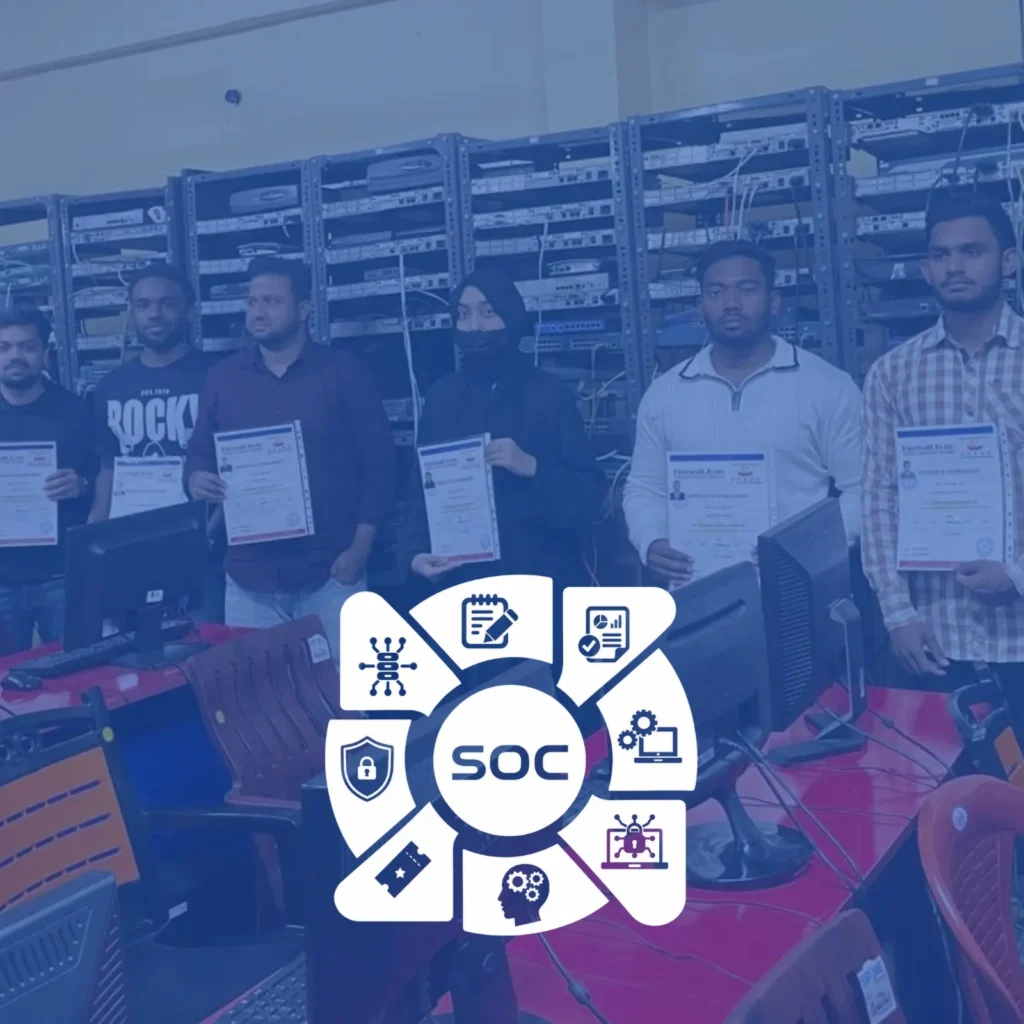
25+years of Experience Highly Equipped Labs with Latest Advanced Equipments 100+Routers, Switches and Firewalls Highly Qualified Experienced Faculty |

Firewall Zone labs

What Will You Become After Completing This Course?

After successful completion of the SOC Analyst Training Program, learners can pursue careers such as:

  1. SOC Analyst (L1 & L2)
  2. Cyber Security Analyst
  3. SIEM Analyst
  4. Security Operations Analyst
  5. Incident Response Analyst
  6. Threat Hunter
  7. Security Monitoring Analyst
  8. Network Security Analyst
  9. Security Engineer
  10. SOC Engineer

The course is designed to provide practical knowledge and hands-on training that organizations seek when hiring cybersecurity professionals.

Course Curriculum

Cyber Security SOC Analyst Training – SIEM (SPLUNK)

Networking for SOC Analyst

  • Introduction to organization campus & WAN network
  • OSI & TCP/IP models
  • Protocols and port numbers
  • Introduction to router and its configuration
  • Packet flow and packet inspection using Wireshark
  • Identifying port numbers using NMAP

SOC Fundamentals

  • SOC organizational structure
  • SOC overflow
  • Introduction to SOC tools
  • Tasks in SOC Analyst

Cyber Security Concepts – SOC Engineer

  • Introduction to security CIA, encryption and hashing
  • Defence in depth approach
  • Cyber kill chain or phases of attacks
  • Brute force attack and types
  • Phishing and spoofing attacks
  • OWASP TOP 10

Understanding SPLUNK SIEM & SOC Process

  • Splunk installation
  • Splunk universal forwarder installation
  • Introduction to Splunk

Understanding Various Logs & Dashboards

  • Uploading and understanding firewall logs
  • Understanding Windows logs and event IDs
  • Splunk dashboard creation
  • Windows Sysmon log analysis

SIEM Use Cases & Threat Handling

  • Incident handling stages
  • Malware outbreak analysis
  • SIEM use cases

Threat Hunting

  • Threat hunting – scanning attack on web servers
  • Threat hunting – brute force attack
  • Email address analysis

Certified Ethical Hacker Powered by AI

MODULE 01

Introduction to Ethical Hacking

  • Basics of ethical hacking
  • Hacker types & hacking phases
  • MAC address and IP spoofing attacks
MODULE 02

Footprinting and Reconnaissance

  • Footprinting through search engines
  • Whois footprinting
  • DNS footprinting
  • Footprinting countermeasures
MODULE 03

Scanning Networks

  • Network scanning concepts
  • Host discovery
  • Port and service discovery – NMAP
MODULE 04

Enumeration

  • Enumeration concepts
  • NetBIOS enumeration
  • LDAP enumeration
  • Other enumeration techniques – using NMAP
MODULE 05

Vulnerability Analysis

  • Vulnerability assessment concepts
  • Vulnerability classification and assessment
MODULE 06

System Hacking

  • System hacking concepts
  • Gaining access using exploits
  • Gaining access to Linux and Windows systems
  • Clearing logs
MODULE 07

Malware Threats

  • Malware concepts
  • Trojan concepts
  • Virus and worm concepts – creating backdoor using msfvenom
MODULE 08

Sniffing

  • Sniffing concepts
  • Sniffing technique: MAC attacks
  • Sniffing technique: DHCP attacks
  • Sniffing technique: ARP poisoning
  • Sniffing technique: spoofing attacks
MODULE 09

Social Engineering

  • Social engineering concepts
  • Social engineering techniques
MODULE 10

Denial-of-Service

  • DoS/DDoS concepts
  • DoS/DDoS attack techniques
MODULE 11

Session Hijacking

  • Session hijacking concepts
  • Application-level session hijacking
MODULE 12

Evading IDS, Firewalls, and Honeypots

  • IDS, IPS, firewall, and honeypot concepts
  • IDS, IPS, firewall, and honeypot solutions
MODULE 13

Hacking Web Servers

  • Web server concepts
  • Web server attacks
  • Web server attack methodology
  • Web server attack tools
MODULE 14

Hacking Web Applications

  • Web application concepts
  • Web application threats
MODULE 15

SQL Injection

  • SQL injection concepts
  • SQL injection methodology
MODULE 16

Hacking Wireless Networks

  • Wireless concepts
  • Wireless encryption
  • Wireless threats
  • Wireless hacking methodology
MODULE 17

Hacking Mobile Platforms

  • Mobile platform attack vectors
  • Hacking Android OS
MODULE 18

IoT and OT Hacking

MODULE 19

Cloud Computing

MODULE 20

Cryptography

  • Cryptography concepts
  • Encryption algorithms

Network Security for SOC Analyst

Network Security Domains

  • Asset Security
  • Security Engineering
  • Communications & Network Security
  • Identity & Access Management
  • Security Assessment & Testing
  • Security Operations
  • Software Development Security

Security Standards & Auditing

Security Standards

CIA, Governance, COBIT, ISO, OCTAVE

Auditing

Compliance, Regulatory Requirements, ISO 27001 Docs

Firewall Security for SOC Analyst

Firewall Configuration & Security

  • Zones & Interfaces
  • Virtual Router
  • Security Policies
  • NAT
  • Security Profiles & Groups
  • Firewall policies, web filtering, antivirus, IPS, DoS, anti-spam
  • VPN configuration – site-to-site and remote access VPN
  • Configuring high availability

Endpoint Security

Endpoint Security Fundamentals

  • What is endpoint security
  • Importance & components
  • Product selection
  • Planning & implementation

Installation, Detection & Monitoring

  • Server & console installation
  • Agent profiles & remote installation
  • Detection & prevention
  • Monitoring & reporting

Network Security Management

Monitoring & Management

  • Monitoring, event management & log server
  • Choosing products & features
  • Planning & implementing management server
  • Configuring servers & dashboards

What Will You Become After Completing This SOC Analyst Course?

Upon successful completion of the SOC Analyst Training program, students will be prepared for in-demand Cyber Security job roles including SOC Analyst, Cyber Security Analyst, SIEM Analyst, Threat Hunter, Security Operations Engineer, Network Security Analyst, and Incident Response Analyst. With hands-on training in Splunk SIEM, Threat Hunting, Log Analysis, Ethical Hacking, Network Security, Firewall Security, and Security Operations, learners gain practical skills that are highly valued by organizations worldwide. The course is designed to help students build a strong foundation for a successful career in the Cyber Security industry.

Training Methodology

Why Choose SOC Analyst Training?

Organizations across the world are facing an increasing number of cyber threats, data breaches, phishing attacks, ransomware incidents, and advanced persistent threats. SOC Analysts play a critical role in monitoring security events, identifying cyber threats, investigating incidents, and protecting enterprise environments.

Our training helps learners develop the skills needed to:

  1. Monitor and analyze security events
  2. Investigate cyber attacks and incidents
  3. Perform threat hunting activities
  4. Understand attacker techniques and methodologies
  5. Work with SIEM technologies such as Splunk
  6. Analyze Windows, Firewall, Sysmon, and Security logs
  7. Understand SOC processes and workflows
  8. Build real-world cybersecurity operational skills

SOC Analyst Prerequisites

No Prerequisites

.

Lesson Duration

Level

beginner

Class Room Training

Real Time Devices

Career Opportunities

SOC Analyst (Level 1)

SOC Analyst (Level 2)

Security Analyst

Cyber Security Analyst

SIEM Analyst

Incident Response Analyst

Threat Hunter

Security Operations Engineer

Security Monitoring Analyst

Network Security Analyst

Why Choose Firewall Zone Institute of Technology for SOC Analyst Training?

Enroll in the Best SOC Analyst Training in Hyderabad

Start your cyber security journey with practical, job-oriented SOC Analyst training and develop the skills required to work in modern Security Operations Centers.

info@firewall-zone.com

040-23530263

+91 888 619 2132

Opp: Pillar No: 3, Royal Colony, Mehdipatnam, Hyderabad, Telangana, India

    Expert support and industry-leading training in CCNA RS, CCNP Security, Networking, and Cyber Security Courses, empowering individuals with the skills to achieve independence, career growth, and technical excellence.

    Reach Us

    Helpful LInks

    © 2026 Firewall Zone Institute of IT

      Best Networking Institute in Hyderabad with Real‑Time Devices