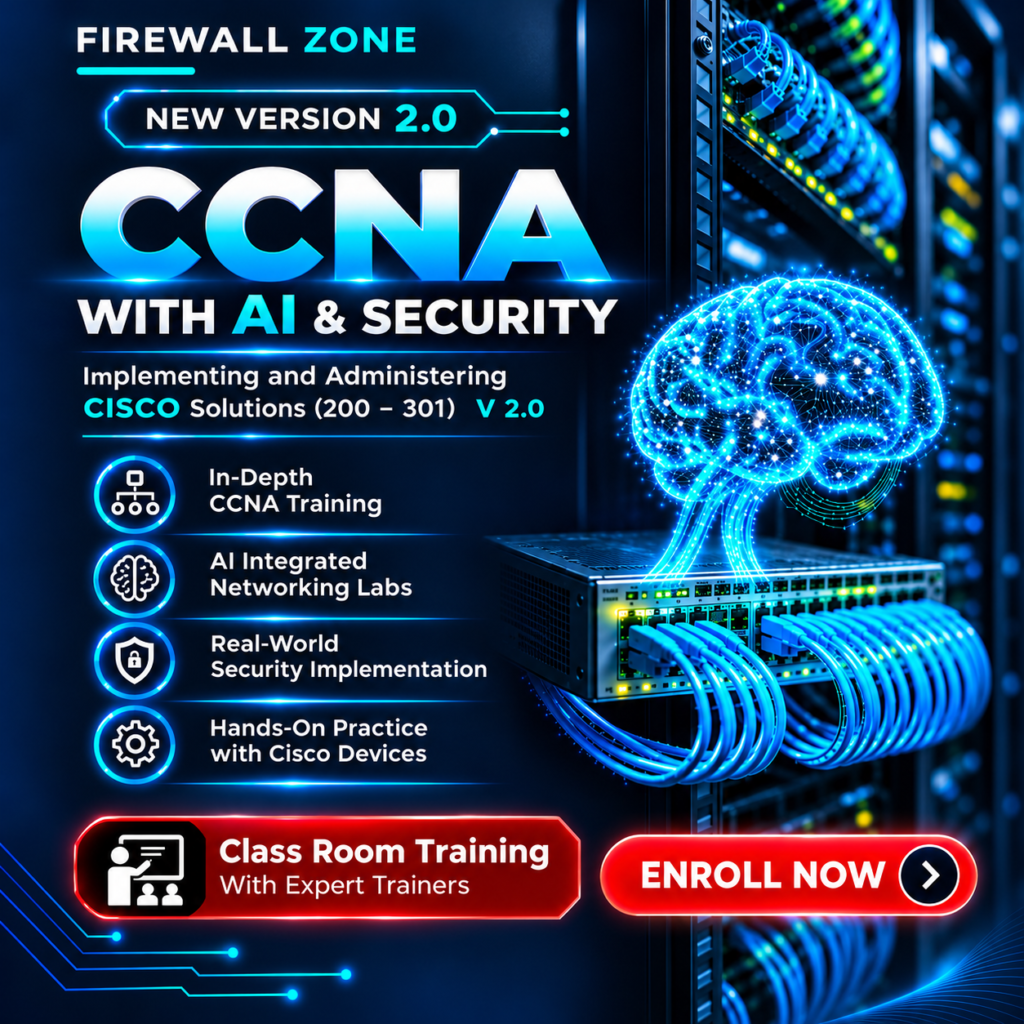
CCNA with AI & Security New Version 2.0 Implementing and Administration

Because CCNA Training in Hyderabad covers so many IT fundamentals, it’s a great way to stand out no matter where your career takes you.

CCNA with AI & Security

New Version 2.0

Implementing and Administration
CISCO Solutions (200-301) V2.0

CCNA with AI Starting on 2nd November 2026 |

CCNA Training in Hyderabad at Firewall Zone Institute of IT Career in Networking begins with CCNA with AI & Security New Version 2.0 (Routing & Switching) + Security at Firewall Zone Institute of IT. (200-301 exam) CCNA (Routing & Switching) + Security Training in Hyderabad at Firewall Zone Institute of IT is led by Cisco-certified professionals and designed to help you master both enterprise-grade network architecture and foundational security protocols. Learn through hands-on labs, real-world deployment scenarios, and tool-specific modules covering IP addressing, routing protocols, VLANs, ACLs, VPNs, and Cisco IOS security features. Build practical skills in network configuration, traffic control, device hardening, and threat mitigation—making you job-ready for roles in IT infrastructure and cybersecurity.

Why Firewall Zone
25+years of Experience Highly Equipped Labs with Latest Advanced Equipments 100+Routers, Switches and Firewalls Highly Qualified Experienced Faculty |

Firewall Zone labs

What You'll Learn

  • 100% Hands-on Training
  • Real Cisco Equipment
  • Industry Expert Trainers
  • Job-Ready Skills
  • Certification Guidance

Course Curriculum

Networking, AI & Network Operations Training

CCNA Training in Hyderabad at Firewall Zone Institute of IT. Complete networking curriculum covering networking essentials, switching, routing, network security, automation and AI-powered network operations.

01

Networking Essentials

Chapter 1 – Basic Concepts

  • What is a Network?
  • Types of Networks
  • Common Physical Components
  • Benefits and Working of Networks
  • Network Design Considerations

Chapter 2 – OSI Model

  • Introduction to the OSI Model
  • The Seven-Layer Approach
  • Host-to-Host Communication

Chapter 3 – TCP/IP Addressing

  • Addressing Basics and IPv4 Format
  • IP Classes and Default Subnets
  • Private and Public IP Addresses
  • TCP, UDP and Port Numbers

Chapter 4 – Advanced Subnetting

  • Subnet Masks and CIDR Notation
  • Subnet Calculation and Address Planning
02

LAN & Switching

Chapter 1 – Ethernet Basics

  • Ethernet Technology and Communication Methods
  • Logical and Physical Addresses
  • Twisted-Pair and Fiber-Optic Cables
  • Hubs, Bridges and Switches
  • Managed and Unmanaged Switches
  • Switching Hierarchy

Chapter 2 – Cisco Switches

  • Switch Setup and Basic Configuration
  • Interface Configuration and Verification

Chapter 3 – Cisco IOS

  • Command-Line Interface and IOS Commands

Chapter 4 – VLAN, Trunks & VTP

  • VLAN Creation and Trunk Configuration
  • VLAN Trunking Protocol Fundamentals

Chapter 5 – STP & EtherChannel

  • Spanning Tree Protocol
  • EtherChannel Configuration
03

WAN & Routers

Chapter 1 – Introduction to Routers

  • Router Components and Boot Process
  • Startup Status and Router Access
  • Router Modes and Common SHOW Commands

Chapter 2 – Basic Configuration

  • Hostname, Login Banner and Passwords
  • Console Commands and Access
  • Saving and Deleting Configurations
  • Interface Setup and IP Addressing
  • Configuration Verification

Chapter 3 – WAN Configuration

  • WAN Connections and Protocols
  • Serial Interface and Encapsulation
  • Clock Rate Configuration
  • Connectivity Testing and Verification
04

Routing Technologies

Chapter 1 – Static & Default Routing

  • Configuring and Verifying Static Routes
  • Default Route Configuration

Chapter 2 – Dynamic Routing

  • Routing Benefits and Protocol Types
  • RIP Configuration and Verification

Chapter 3 – OSPF

  • Features, Functionality and Operation
  • OSPF Setup and Configuration

Chapter 4 – EIGRP

  • EIGRP Features and Benefits
  • Designing and Implementing EIGRP

Chapter 5 – BGP

  • Exterior Gateway Protocol Fundamentals
  • BGP Peering and Route Advertisement
05

WAN Technologies

  • Physical and Logical WAN Connectivity
  • WAN Protocols and Their Functions

Chapter 1 – PPP & HDLC

  • Features and Configuration
  • SD-WAN Overview

Chapter 2 – Frame Relay

  • How Frame Relay Works
  • Design and Implementation

Chapter 3 – VPN

  • VPN Functions and Components
  • Secure Remote Connectivity Fundamentals
06

Router Security

  • Importance of Router Security
  • Security Mechanisms and Protection

Chapter 1 – Access Control Lists

  • ACL Types and Features
  • Standard and Extended ACL Configuration

Chapter 2 – NAT

  • Network Address Translation Fundamentals
  • NAT Configuration and Live Project
07

Network Management & IPv6

Chapter 1 – IPv6

  • Why IPv6? Features and Benefits
  • IPv6 Addressing and Implementation

Chapter 2 – Device Management

  • Remote Device Access and Administration
  • Configuration Backup and Restore
  • IOS Backup and Updating

Chapter 3 – Network Monitoring

  • Network Health and Performance Monitoring
  • Syslog Basics and Device Event Monitoring
  • Network Troubleshooting Fundamentals
NEW MODULE · AI & AUTOMATION
08

AI & Network Operations and Management

Chapter 1 – Agentic AI in Networking

  • Describe the role of Agentic AI in network operations
  • Understand AI-assisted network monitoring and troubleshooting
  • Explore AI agents for network automation and operational workflows

Chapter 2 – Generative AI & Prompt Engineering

  • Write prompts that instruct generative AI systems to produce a specified output format
  • Define clear instructions, context, constraints and expected results
  • Use AI to assist with network configuration and troubleshooting tasks

Chapter 3 – Network Management Approaches

  • Describe different network management approaches
  • Understand monitoring, configuration, fault and performance management
  • Explore centralized management and automation workflows

Chapter 4 – Python Configuration Management

  • Use Python-based configuration management mechanisms to execute commands
  • Automate routine network administration tasks
  • Apply validation and verification to configuration changes

Chapter 5 – Syslog Analysis

  • Interpret syslog message content and structure
  • Understand syslog severity levels
  • Identify syslog facilities and their purposes
  • Use log information to support network troubleshooting
Practical Training: Setting up and troubleshooting small-to-medium LAN/WAN environments, configuring network devices, monitoring network events and exploring Python-based automation and AI-assisted network operations.

Upon Successful Completion of CCNA (R&S + Security)

Upon successful completion of this course, you will be prepared to sit for the Cisco CCNA certification exam with added expertise in security fundamentals. You’ll gain the skills to configure, manage, and troubleshoot enterprise networks while implementing essential security measures such as firewalls, VPNs, and intrusion prevention systems. This training positions you for roles like Network Engineer, Security Analyst, or IT Infrastructure Specialist, giving you a strong foundation to advance in the networking and cybersecurity field.

Training Methodology

CCNA Cisco Certified Network Associate:

Upon successful completion of this course, you’ll be prepared for industry-recognized certification exams.

CCNA Prerequisites

No Prerequisites

.

Lesson Duration

30 Days

Level

beginner

Class Room Training

Real Time Devices

Career Opportunities

Network Administrator

Network Support Engineer

Junior Network

Network Engineer

IT Support Specialist

Why Choose This Training?

Get In Touch with Us Anytime!

Have questions? We’d love to hear from you. Send us a message and we’ll respond as soon as possible.

info@firewall-zone.com

040-23530263

+91 888 619 2132

Opp: Pillar No: 3, Royal Colony, Mehdipatnam, Hyderabad, Telangana, India


    Expert support and industry-leading training in CCNA RS, CCNP Security, Networking, and Cyber Security Courses, empowering individuals with the skills to achieve independence, career growth, and technical excellence.

    Reach Us

    Helpful LInks

    © 2026 Firewall Zone Institute of IT

    Student Enquiry Form

      Firewall Zone_ Dual Cybersecurity Courses